Free Nonprofit Board Meeting Evaluation Template
A Quick Check That Makes Your Next Meeting Better
Most boards never stop to ask how their meetings are going, so the same frustrations carry over from one meeting to the next. Packets go unread and discussions never get to the big question. But nobody says anything out loud.
This free nonprofit board meeting evaluation template gives your board an easy way to start identifying areas for improvement. Members answer 22 short questions in two to three minutes at the end of the meeting, and over a few months you'll see patterns you can act on. The template comes with a short guide for whoever runs the evaluation and reads the results.
Get the free Board Meeting Toolkit
Thank you for requesting The Board Meeting Toolkit.
Check your email in a few minutes. It's on its way!
You'll receive the download link by email. No spam. Unsubscribe anytime.


What You Get
Nonprofit Board Meeting Evaluation Template
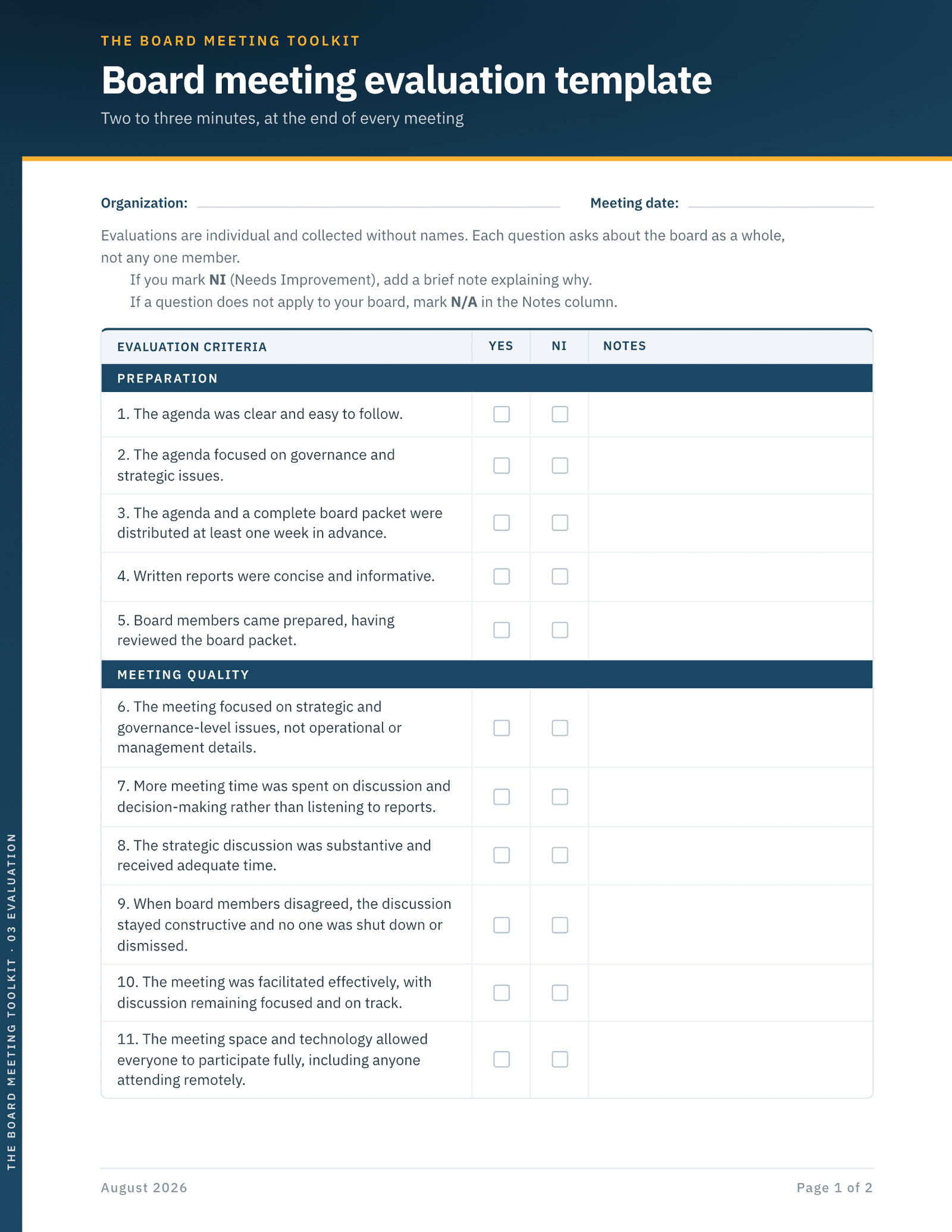
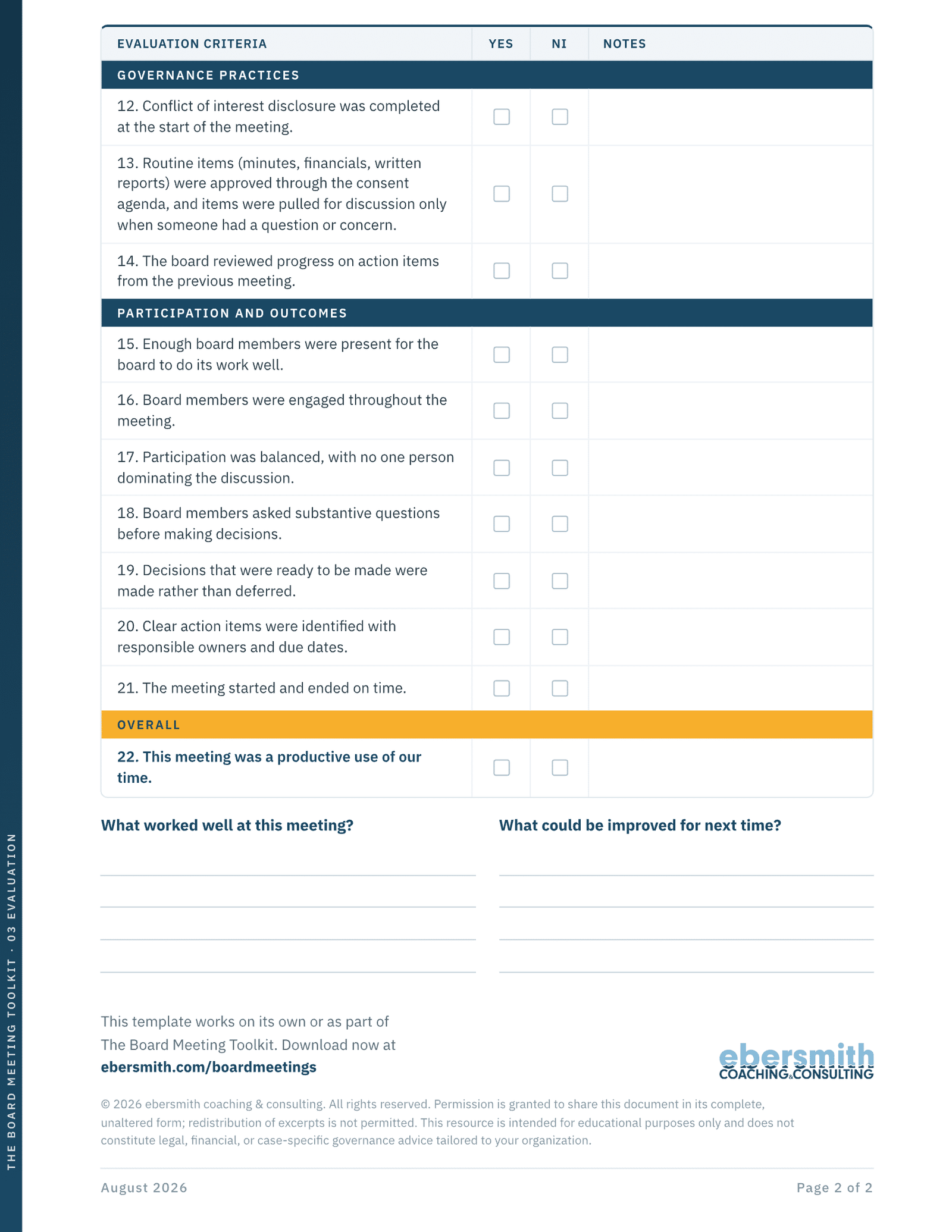
The template asks 22 questions in five sections: preparation, meeting quality, governance practices, participation and outcomes, and an overall rating.
Members mark each one Yes or Needs Improvement. Anyone who marks Needs Improvement adds a short note.
Evaluation Guide and Ready-Made Forms
The guide explains what each question is checking and what to do when the same answer keeps showing up.
It also comes with a ready-made Google Form and Microsoft Form, so members can answer anonymously online.
Sample Nonprofit Board Meeting Evaluation
Here's a look at the evaluation template. It starts with how prepared members were and how the meeting ran, then asks about governance practices and whether everyone took part. It closes by asking if the meeting was a productive use of everyone's time, along with two open questions about what worked well and what could be better next time.
Yes or Needs Improvement
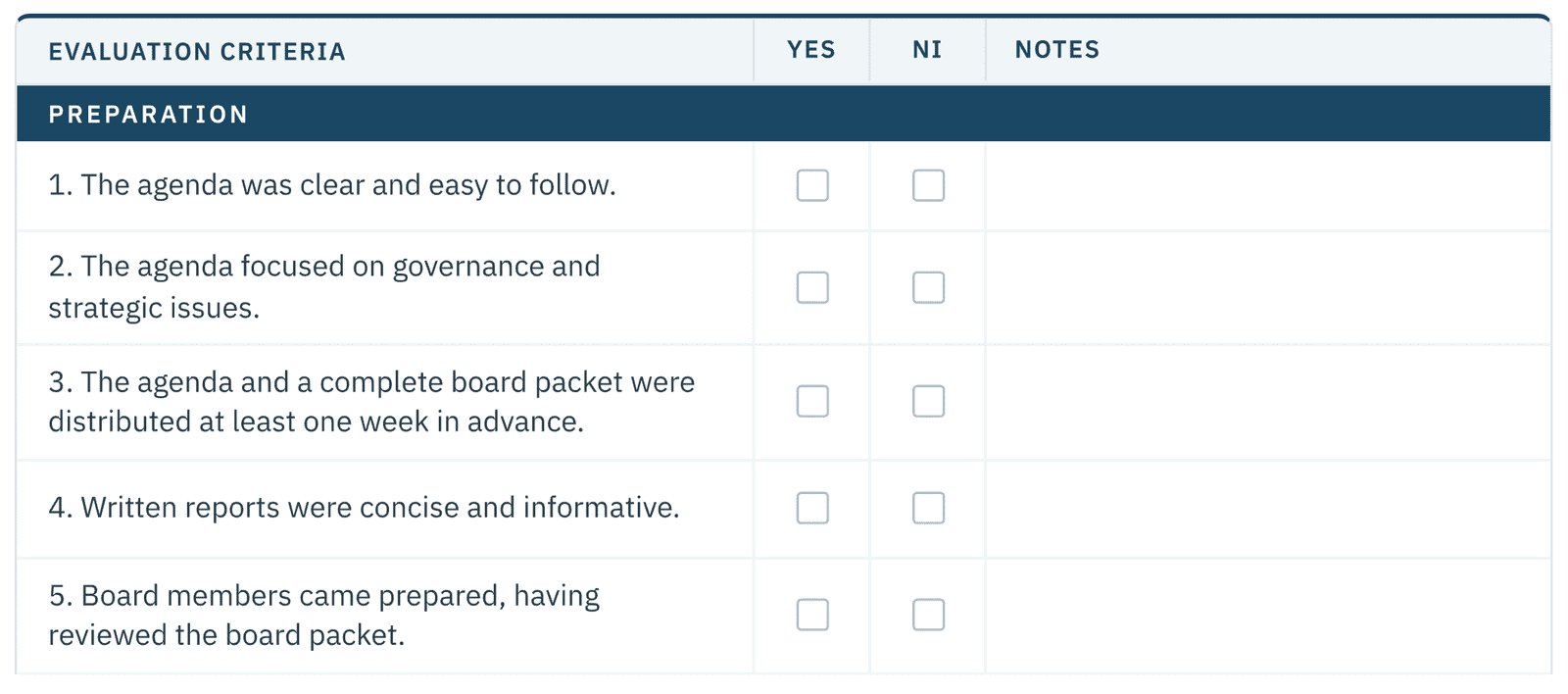
Every question has two answers: Yes or Needs Improvement. Members pick one for every question, and the note on each Needs Improvement is what tells you what to change.
When you hand it out, tell members:
- Mark each question Yes or Needs Improvement
- Add a short note for anything marked Needs Improvement
- If it was somewhere in between, mark Needs Improvement
- If a question doesn't apply, write N/A in the Notes column
One evaluation won't tell you much on its own. Look at five or six meetings together and the patterns start to show, like the same question getting Needs Improvement every time.
Make the evaluation the last item on every agenda, and have the chair hold two or three minutes for it so it doesn't get dropped if the meeting runs long.
Part of the Free Board Meeting Toolkit
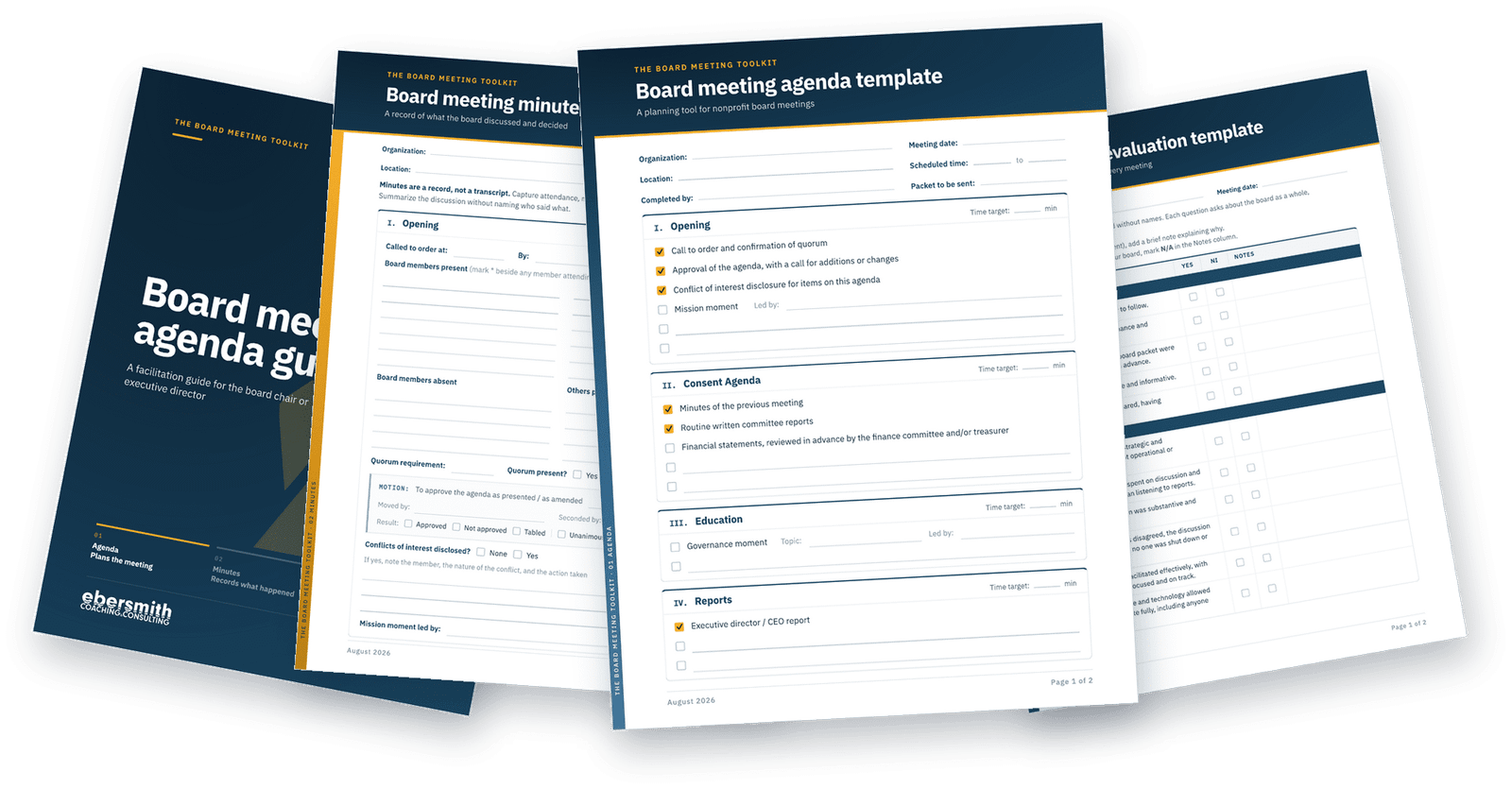
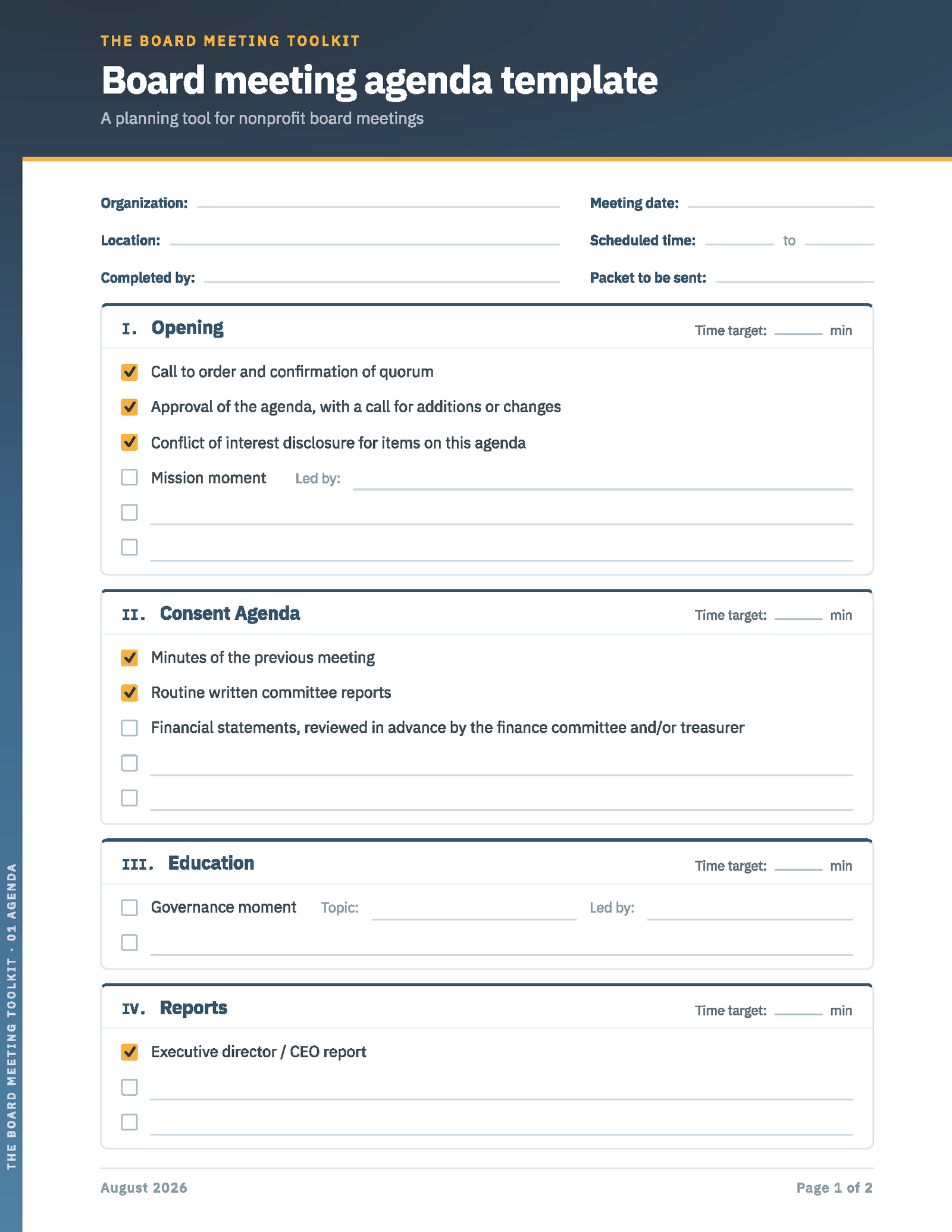
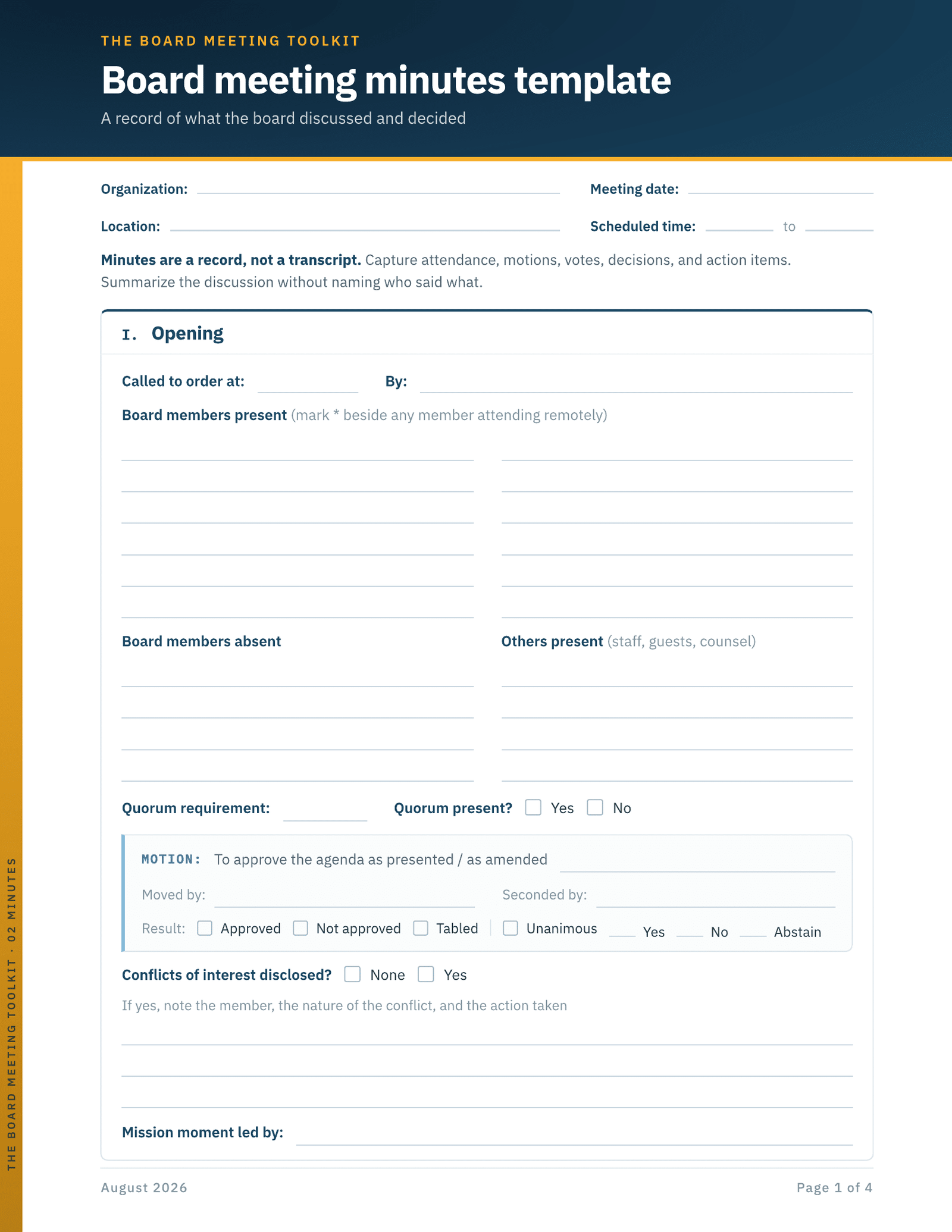
The evaluation template is one of three in the Board Meeting Toolkit. The agenda template sets up the meeting and saves a spot at the end for the evaluation. The minutes template follows the same sections as the agenda, so whoever takes minutes can work straight down the page.
You can get all three in one download. Click the button below to get it.
Frequently Asked Questions
What is a board meeting evaluation?
A board meeting evaluation is a short set of questions board members answer at the end of a meeting about how that meeting went. It looks at things like whether members came prepared, whether the discussion got to the questions that matter, and whether everyone had a chance to take part. It takes two to three minutes, and the real value comes from looking at the answers across several meetings.
What questions should a board meeting evaluation ask?
A good evaluation covers five areas: how prepared members were, how the meeting ran, whether good governance practices were followed, whether everyone took part and the meeting produced clear outcomes, and whether it was a productive use of time. Keep the questions specific enough that a Needs Improvement points to something you can fix.
Is a board meeting evaluation the same as a board self-assessment?
No. A meeting evaluation looks at one meeting and takes a few minutes to complete. A board self-assessment looks at how the board is doing as a whole, and most boards do one once a year. If you're looking for that bigger picture, that's what our Board Health Check is built for.
Should board meeting evaluations be anonymous?
Yes. People are more candid when their names aren't attached to their answers. That's why the toolkit includes a ready-made Google Form and Microsoft Form that collect responses anonymously.
Can we change the evaluation template?
Yes, for your own board's use. Add questions that fit your board or drop ones that don't apply. Just keep two things: a note for every Needs Improvement, and a look at the results across several meetings instead of one at a time. The license doesn't allow passing an altered version on to someone else. If you want to share it with another organization, please share the link to the full Board Meeting Toolkit page so they get all six files and the most recent updates.

I'm Jeff Smith.
I've spent close to twenty years working with nonprofit boards, as a program officer funding them, as an interim executive director reporting to one, and now as a BoardSource Certified Governance Consultant helping them get stronger. I've sat through plenty of board meetings that accomplished little, and read plenty of minutes that were really transcripts of who said what. Very few of those boards ever stopped to ask whether their time together was well spent. I developed this toolkit for board chairs and executive directors who know their meetings could be better but aren't sure how to get there.
ebersmith coaching & consulting is based in Scranton, PA. I work with nonprofits and foundations nationally.
When the Pattern Keeps Repeating
A regular evaluation can make your next board meeting better. But if the same questions keep coming back Needs Improvement, like packets that go unread or decisions that keep getting put off, that's usually a governance question, and it helps to find out what's behind it.
Here's where to go next, depending on what your board needs:
Take the Quiz: a five-minute quiz that shows which of five patterns your board is in, from ten questions about how it's built and how it works.
Board Health Check: a board-wide self-assessment that shows how the board sees itself across composition, culture, structure, and the board-ED partnership.
Board Foundations: a three-month focused engagement for boards that have named specific governance work they want to do, such as recruitment or meeting culture.