The Board Meeting Toolkit
Free Nonprofit Board Meeting Templates
Agenda, Minutes, and Evaluation Templates, in One Kit
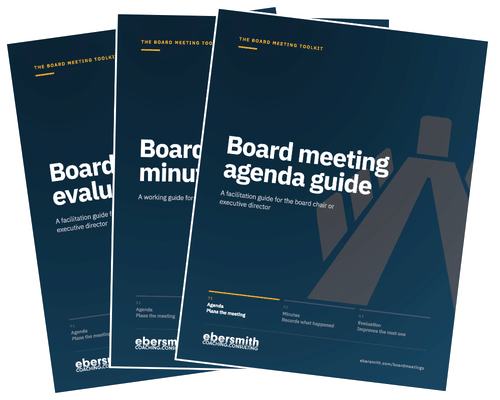
An agenda template that prioritizes strategic discussion
A minutes template that helps capture decisions without writing a transcript
A meeting evaluation your board can complete before it leaves the room
A companion guide for each template, written for the board chair or executive director
Download the free toolkit and start using it at your next board meeting.
You'll receive the download by email. No spam. Unsubscribe anytime.
The Board Meeting Toolkit
What's Included
Nonprofit Board Meeting Agenda Template and Guide
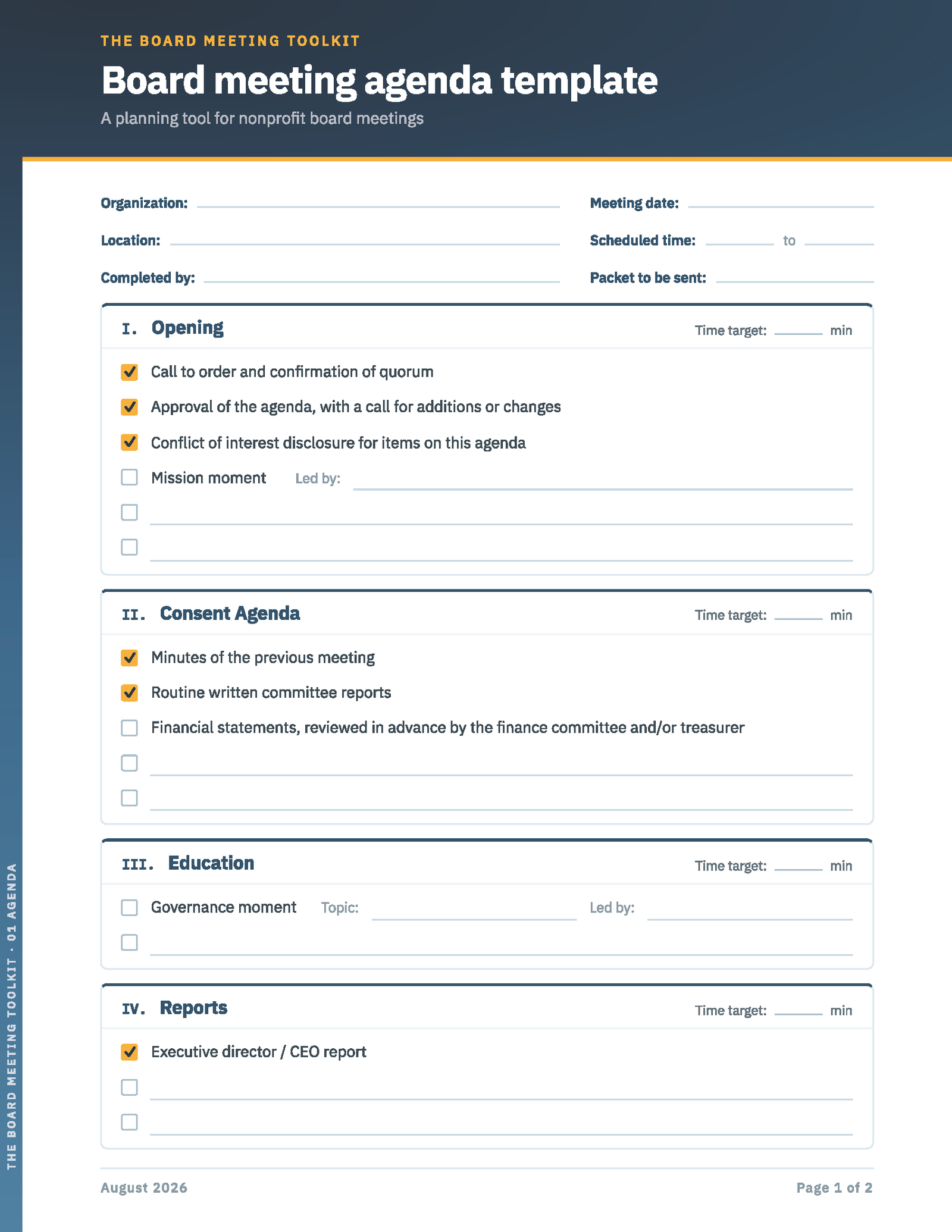
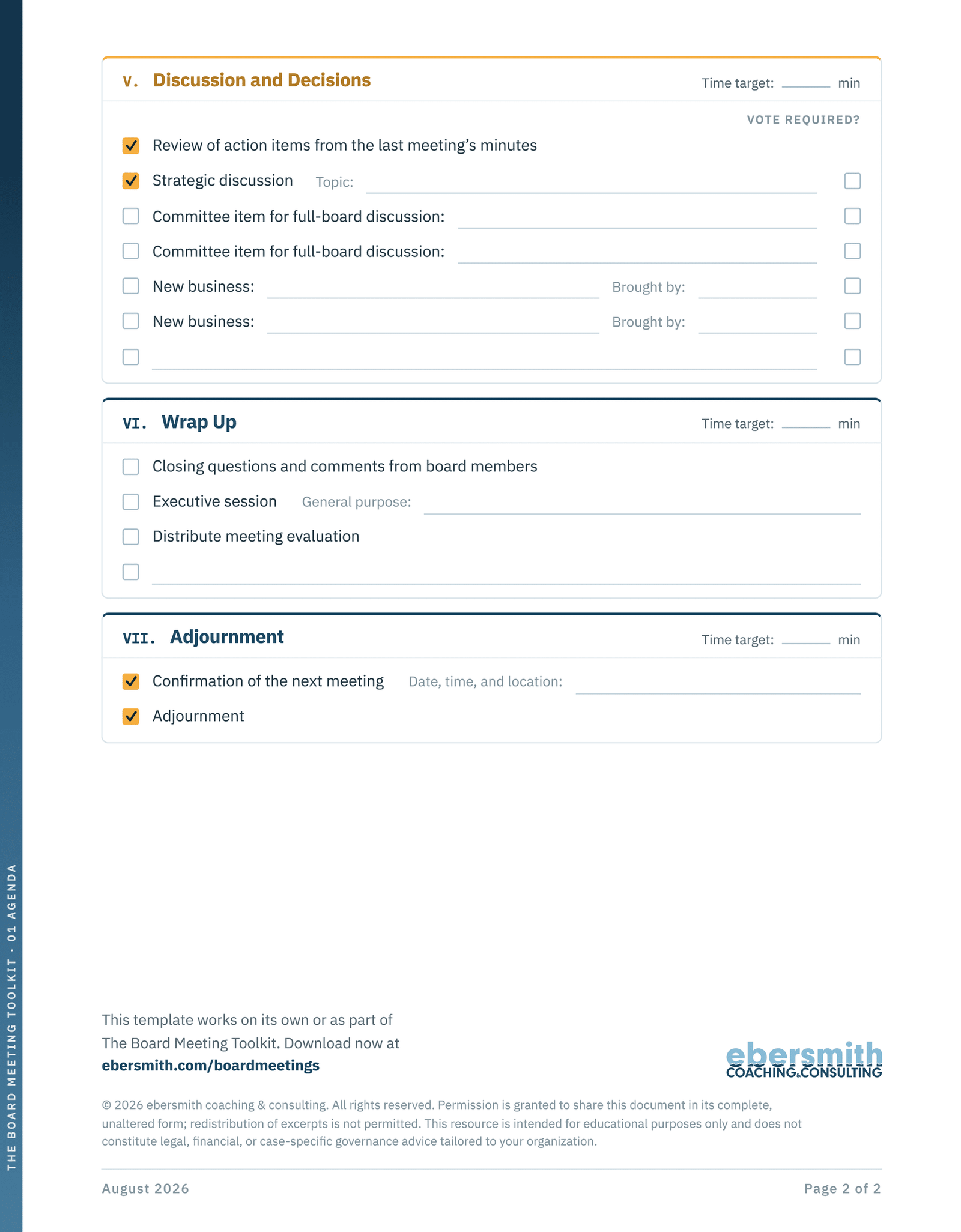
The agenda template puts governance items first and gives strategic discussion a dedicated block of time.
It includes a consent agenda for routine approvals, a standing place for conflict-of-interest disclosure, and a closing review of action items with owners and due dates.
The guide walks through each section and what belongs in it, and includes a completed sample agenda.
Nonprofit Board Meeting Minutes Template and Guide
The minutes template records what the board decided rather than what everyone said.
It gives every vote a structured motion block, keeps an attendance record, and leaves a place for conflicts disclosed during the meeting.
The guide covers what to include and what to leave out, how to handle executive session, how corrections and approval work at the next meeting, and sample minute entries.
Nonprofit Board Meeting Evaluation Template and Guide
The evaluation is 22 questions your board can answer in two to three minutes before it leaves the room.
Along with the printable template, you’ll receive access to a ready-made Google Form and a Microsoft Form you can copy and start using right away.
The guide explains each question in detail and what to do when a pattern starts to emerge.
Sample Nonprofit Board Meeting Agenda
Here is the template for a strong nonprofit board meeting agenda. It follows three rules: routine approvals are batched into a consent agenda so they take minutes instead of an hour, reports are distributed in advance and not read aloud, and strategic discussion gets a dedicated, protected block of time.
The full toolkit includes this template plus a guide that walks through what belongs in each section, how to run a consent agenda, and a completed version you can adapt. Download it below.
Download the free toolkit and start using it at your next board meeting.
You'll receive the download by email. No spam. Unsubscribe anytime.
Frequently Asked Questions
What should be on a nonprofit board meeting agenda?
A strong nonprofit board meeting agenda puts routine approvals in a consent agenda, keeps reports short because they were distributed in advance, and protects a dedicated block for strategic discussion. It should also include a standing place for conflict-of-interest disclosures and close with a review of action items, owners, and due dates.
How detailed should board meeting minutes be?
Minutes should record decisions, not discussion. For each motion, the record shows who moved it, who seconded, and the outcome. You may need to summarize the deliberation in a sentence or two if that context will matter later.
Your bylaws and your state may set additional requirements, so check those or ask your attorney before settling on a format.
Do we have to evaluate every meeting?
A single evaluation won’t tell you much. The value shows up across five or six meetings, when the same question keeps coming back marked Needs Improvement and a pattern begins to emerge.
Our evaluation template should take two to three minutes to complete. We recommend building it into every meeting agenda, compiling the responses in one place, and reviewing them after five to six months of consistent use.
Can we change the templates?
Yes, for your own board's use. A twenty-person governing board and a five-person advisory board don't need identical forms, and the guides flag which pieces are worth keeping if you adapt the rest.
What the license doesn't allow is passing an altered version along to someone else. If you want to share the toolkit with another organization, we ask that you share the link to this page so they can get access to all six files, as well as the most recent updates.
Which template should I use first?
Start thinking of your board meetings as a cycle, not as a single event. Eventually you should be using all three - the agenda to plan the meeting, the minutes to record what happened, and the evaluation to improve the next one.
Start with the one that addresses your board's loudest symptom:
- Meetings drift, run long, or run out of time for strategic discussion - start with the agenda template.
- Follow-through is unclear or decisions get re-litigated - start with the minutes template.
- Meetings feel unproductive but no one can say exactly why - start with the evaluation template.

I'm Jeff Smith.
I’ve spent close to twenty years working with nonprofit boards, as a program officer funding them, as an interim executive director reporting to one, and now as a BoardSource Certified Governance Consultant helping them get stronger. I have sat through plenty of board meetings that accomplished little, and read plenty of minutes that were really transcripts of who said what. Very few of those boards ever stopped to ask whether their time together was well spent. I developed this toolkit for board chairs and executive directors who know their meetings could be better but aren't sure how to get there.
ebersmith coaching & consulting is based in Scranton, PA. I work with nonprofits and foundations nationally.
What's Next
When the pattern keeps repeating
A better agenda can improve your next board meeting. But if every meeting ends with the same frustrations - decisions that never quite get made, action items no one owns, board members who quietly disengage - the problem is usually governance, not formatting. Templates treat the symptoms. When the pattern keeps repeating, it is worth understanding what is actually driving it.
Here's where to go next, depending on what your board needs:
Take the Quiz: A five-minute diagnostic that places your board in one of five archetypes based on ten questions across composition, function, and governance practice.
Board Health Check: is a board-wide self-assessment that gives a complete picture of how the board sees itself across composition, culture, structure, and the board-ED partnership.
Board Foundations: a three-month focused engagement for boards that have identified specific governance work they want to do: recruitment , the board/ED relationship, meeting culture, among others.