Every nonprofit board is either assembled or built. Assembled boards happen by accident. Someone knew someone, a seat was open, and now here we all are. Built boards happen on purpose. The difference shows up in how the board thinks, plans, and interacts.
So how do you know which one you have? Here are six signs of a built board, and what each one looks like in practice.
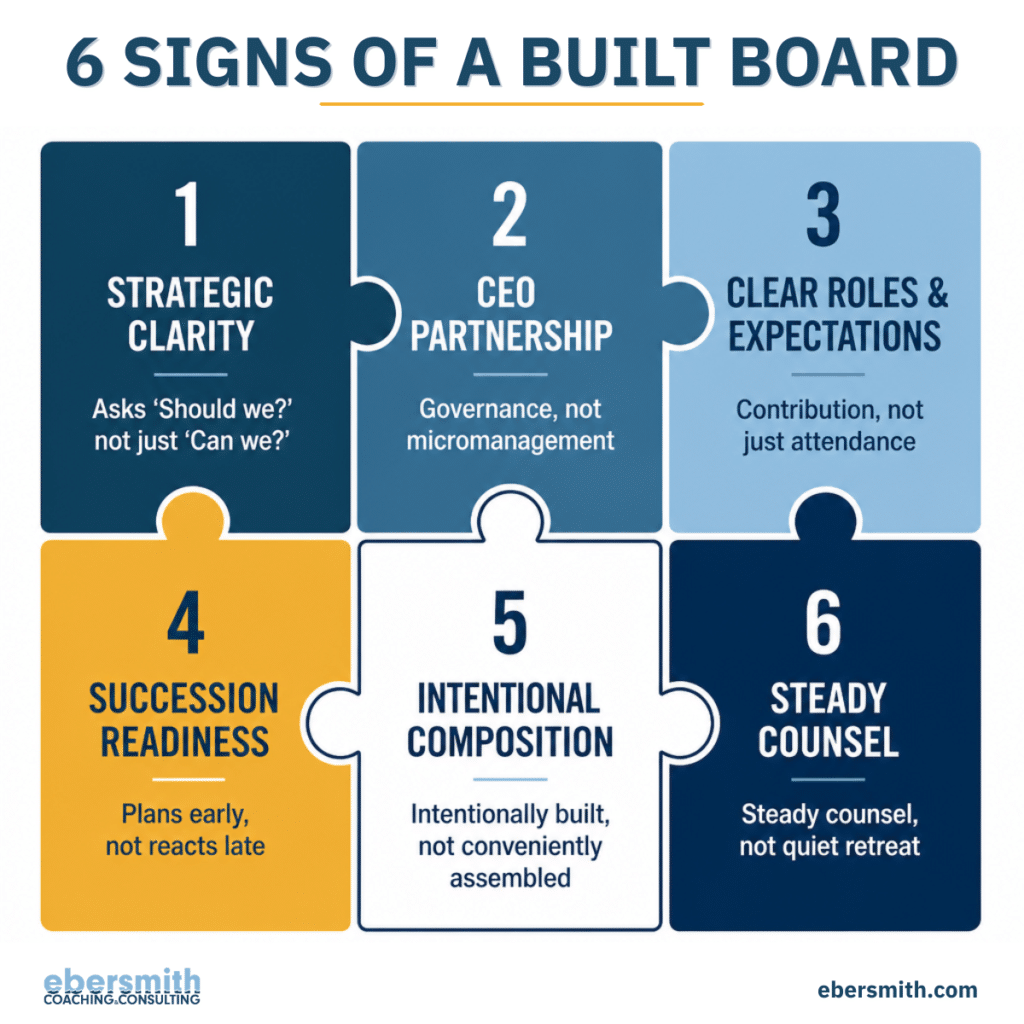
1. Strategic Clarity
Asks "Should we?" not just "Can we?"
Assembled boards spend their energy on logistics. Can we staff it? Can we find the space? Can we pull it off by spring? Those are all necessary questions, but they're management questions. I've written before about where board oversight ends and executive management begins, and execution sits on the management side of that line.
Built boards ask a different question first. Should we do this at all? Does it advance the mission? Can we afford it, not just this year but without putting next year at risk? A board with strategic clarity knows that just because the organization can do something doesn’t mean it should. Some of the best governance questions start with "Can we?" but they end with "Should we?"
2. CEO Partnership
Governance, not micromanagement
The fastest way to lose a great executive director is to hire them for their judgment and then refuse to let them use it.
Built boards understand where their job ends and the CEO's begins. They set direction, establish policy, approve the budget, and hold the executive accountable for results. They do not approve the office supply order, rewrite the newsletter, or second-guess staffing decisions in real time. That crosses the line from oversight into micromanagement.
A real partnership means the CEO can bring the board hard news without fear, and the board can ask hard questions without controlling the day-to-day management.
3. Clear Roles & Expectations
Contribution, not just attendance
Attendance should be the minimum expectation. On an assembled board, though, a member in good standing is often just a member who shows up.
Built boards define what membership actually requires before anyone joins, and they put it in writing. A board member job description or letter of agreement spells out expectations for meeting preparation, committee service, advocacy in the community, and a personally meaningful gift. When those expectations are written down and discussed during recruitment, no one is surprised later, and no one is left guessing about what the role really involves.
If a member disappeared for six months, would the board's work suffer? On a built board, the answer is always yes.
4. Succession Readiness
Plans early, not reacts late
Board officers term out. Executive directors retire, relocate, move on, or burn out. None of this should ever be a surprise, and yet on assembled boards, it often is.
Built boards make succession planning a regular part of how they govern. They maintain a real pipeline for board leadership, so there's always someone preparing to step into an officer role. They have an executive transition plan on paper before they need it. No one serves forever, and everyone in the room should be able to talk openly about who's next.
The earlier that planning starts, the smoother the transition goes.
5. Intentional Composition
Intentionally built, not conveniently assembled
This is the sign that gives built boards their name. Assembled boards recruit from the same familiar networks, which is why so many of them look, think, and decide alike. The open seat gets filled by whoever is available instead of the skills and attributes the board actually needs.
Built boards work through three questions, in a specific order: What does our mission need? What do we currently have? Where are the gaps? Then they intentionally recruit against those gaps. That approach takes patience, but a mismatched appointment fills a seat for a full term.
Who serves on the board shapes every decision the board makes. If your governance committee is ready to work through those three questions together, the Assembled or Built?™ working guide walks you through the whole process.
6. Steady Counsel
Steady counsel, not quiet retreat
When the organization hits turbulence, assembled boards often go quiet. Members stop returning calls, meetings get thin, and the executive director suddenly finds themselves feeling very alone.
Built boards lean in when things get hard. They ask better questions, not fewer. They offer judgment, connections, and calm while the organization works through the problem. A board that offers steady counsel in a hard moment is doing its job.
What This Means for Your Board
If you read this list and recognized more assembly than intention, know that few boards show all six signs. But use these as a guide to see where your board is already strong and where there's still work to do.
Want to know where your board stands? Take the Assembled or Built?™ quiz, or if you'd rather talk it through, let's find a time.
Header Photo by Craig Lovelidge on Unsplash