
It’s January, which means we’re awash in new year energy and fresh starts, but it also means we’re in the second half of the fiscal year for most nonprofits. Budget conversations are coming, strategic planning may be on the horizon, and if you’re like most nonprofit leaders I’ve worked with, there’s probably a program or two that you’ve been quietly avoiding talking about.
You already know it’s struggling. You just don’t have a systematic way to say it out loud.
Why We Don’t Talk About It
Program sustainability is genuinely hard to discuss honestly, in large part because it feels like criticism. Programs accumulate histories and champions over time. A prominent donor started this one, a founder or long-tenured leader has deep personal investment in that one, and “we’ve always done this” becomes its own kind of justification that’s difficult to argue against.
Budget spreadsheets don’t help as much as we’d like them to. They tend to hide struggling programs in line items rather than surfacing them for discussion. Revenue appears in one column, expenses in another, and a net number gets absorbed into the organizational whole. You can spend an hour reviewing a budget and never actually confront the question of which programs are working and which ones aren’t.
What makes it worse is that we tend to conflate “this program loses money” with “this program is bad,” which means we avoid the conversation entirely because no one wants to call a beloved program bad. But losing money doesn’t mean a program is bad. It just means you need to be aware that you’re subsidizing it, and you need to decide whether that subsidy is sustainable.
The Reframe
Not every program is supposed to make money, and that’s okay.
Some programs exist because they’re essential to your mission, even though they’ll never break even. You keep them because they’re why you exist, not because they’re profitable. In the language of one framework I use, these are “Hearts”: programs with high mission impact that nonetheless require subsidy from other parts of your organization.
The real question is whether you can afford to subsidize them, for how long, and what you’re giving up elsewhere in order to do so.
Sustainability isn’t about cutting everything that doesn’t turn a profit; it’s about balance. It’s about understanding which programs generate surplus and which ones consume it, and then making sure the overall math actually works for your organization.
You can run an organization on donations and goodwill alone if that’s intentional and you’re satisfied with the scope of what you can accomplish. But if you want to grow beyond what donations can sustain, you need surplus-generating activities to fund that growth: fee-for-service programs, grant-funded initiatives, revenue streams that produce more than they cost.
Hearts are beautiful, but you can’t build an entire organization out of them. You need some Money Trees too.
Matrix Mapping: A Tool for the Conversation
There’s a framework called matrix mapping that I’ve found useful for making all of this visible. It comes from Nonprofit Sustainability by Jeanne Bell, Jan Masaoka, and Steve Zimmerman, which is worth reading if you want to go deeper into this approach.
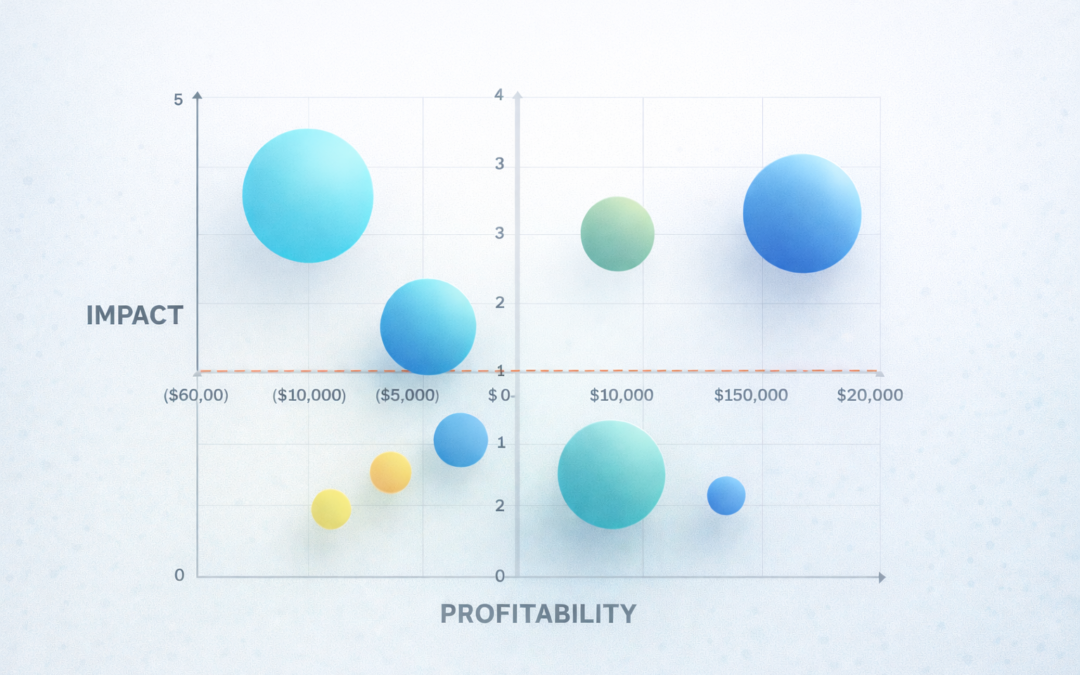
The basic idea is to plot every program and activity your organization runs on two axes. The vertical axis measures mission impact: how much does this program contribute to why you exist? The horizontal axis measures financial contribution: is this program generating surplus or requiring subsidy?
When you map everything out, you end up with four quadrants:
- Stars (high impact, high profitability): These are doing everything right, so invest in them and help them grow.
- Hearts (high impact, low profitability): Keep them because they’re central to your mission, but work to contain the costs, because you can’t subsidize everything forever.
- Money Trees (low impact, high profitability): Nurture these because they fund your Hearts.
- Stop Signs (low impact, low profitability): These require the hardest conversations, because these programs may need to change significantly or end altogether.
What makes this useful isn’t that it reveals shocking surprises. In my experience, leaders usually already know roughly where things will land. The program everyone’s been worried about will show up exactly where you expected it to.
The real value is in validation and communication. Matrix mapping gives you a systematic way to demonstrate what you already sense, and it gives you a visual you can actually point to when you need to have the conversation with your leadership team, your finance committee, or your board. Instead of relying on gut feelings or vague concerns, you have a framework and a picture.
Why Now
January is a good time to start this work. You’re past the holiday rush but not yet deep into next year’s budget process, which means you have a few months before fiscal year-end decisions need to be made.
This isn’t about making decisions today. It’s about building a clearer picture before budget season hits. It’s about having the conversation with your leadership team now, while there’s still time to think rather than just react.
A Place to Start
I’ve put together a set of worksheets you can use to build your own matrix map. It’s not a comprehensive guide, just the tool itself, enough to get started on your own or to bring to your next leadership team meeting.
If you’d like guidance walking through each step, I’ve also created a short email series that accompanies the worksheets and provides context and support along the way.
Download the Matrix Mapping Worksheets →
Matrix mapping can be a great tool for thinking together. Use it to build shared understanding before you need to make hard decisions, not after.
This post contains affiliate links. If you purchase through these links, I may earn a small commission at no additional cost to you.