“Wait, You Want Me to Bring LEGO Bricks to a Board Meeting?”
What would you think if I told you that I facilitate strategic planning sessions with LEGO bricks?
“Isn’t that for kids?” Or maybe, “Are we really going to play with toys while discussing our budget crisis?”
LEGO® Serious Play® isn’t about playing with toys. It’s a research-backed facilitation method grounded in the science of how people actually think, connect, and create. It’s about using your hands to build what your brain is trying to articulate. And after years of working in and with nonprofits as an interim ED, a board member, a consultant, and a capacity builder, I can tell you it works in ways traditional meetings never will.
By the time you finish reading this, you’ll understand why organizations as diverse as Microsoft, NASA, UNICEF, and the University of Southampton use LEGO bricks to find alignment and actually solve problems instead of just talking about them.
What LEGO Serious Play Actually Is
LEGO Serious Play is a structured process where participants build 3D models to represent ideas, challenges, or goals. Everyone builds and everyone shares, which means everyone contributes. There are no PowerPoints, no one person dominating the conversation, and no checking email while pretending to listen.
The method uses specific LEGO sets (yes, there are actual LSP kits with particular pieces designed for this work), combined with carefully crafted questions that guide participants through building physical representations of complex concepts. You’re not building a house or a spaceship. Instead, you’re building things like what’s blocking your team from success or what your organization’s mission means in practice.
Why It Works
Traditional meetings reward whoever talks first, loudest, or longest. We’ve all been in a room with the board member who monopolizes every discussion, the staff member who never speaks up but has brilliant ideas, or the executive team that talks in circles about abstract concepts nobody can quite understand.
LEGO Serious Play changes the entire dynamic. When you’re building with your hands, different parts of your brain engage. The physical act of construction activates creativity, memory, and emotional insight in ways that sitting around a conference table never will. I’ve watched quiet program managers build models that completely reframe strategic discussions, and I’ve seen dominant board chairs forced to wait their turn while everyone else shares first.
The method works because people aren’t just talking about ideas: they’re building them. They’re giving abstract concepts a visible, tangible structure in a way that conversation alone never allows.
There’s also something deeper happening with the format itself. The silent building time gives people who need more processing time a chance to formulate their thoughts before speaking, rather than being expected to respond in real-time. The physical models serve as external memory, so you’re not trying to hold abstract ideas in your head while also listening and tracking the conversation. And the structured turn-taking removes the ambiguity of traditional meeting dynamics, where you’re somehow supposed to intuit when to jump in. For anyone who’s ever felt like traditional meetings weren’t designed for the way their brain works, LSP offers a different way in.
How LEGO Serious Play Helps Nonprofits
After observing and facilitating sessions with different social service organizations, I’ve seen a few areas where LSP makes a real difference.
The biggest one is team and mission alignment. Here’s a story that captures why this matters. I worked with an organization where everyone insisted they were “living the mission.” But when we had each person build what the mission meant to them, we ended up with wildly different models. One person’s mission was all about direct service. Another’s focused on advocacy. A third built something about community partnerships. Everyone genuinely believed they were living the mission. The problem was, they weren’t all living the same mission. No wonder there was tension when some staff thought others weren’t pulling their weight. They were all working hard, just toward different interpretations of the same words. When we built a shared model together, the room shifted. People could see how their different perspectives came from different experiences, both personal and professional. They found the common ground they’d been missing and left with actual alignment, not just the assumption of it.
It also changes how teams interact day-to-day. Ask your team to build “the value you bring to this organization” and watch what happens. Some people build bridges, others build tools, and someone might build a foundation. These aren’t just fun metaphors; they reveal how people see themselves and their roles. One prompt I’ve used is “Build your organization at its best,” and the models that emerge show both aspirations and gaps. When someone builds literal walls between departments, that’s worth discussing. When multiple people independently build similar obstacles, you’ve identified a pattern that needs attention.
Another area is organizational strategy. Nonprofits excel at describing problems, but they can struggle with visualizing solutions. LSP forces you to move from abstract strategy to concrete representation: when you ask a team to build “what success looks like in three years,” you get specifics, and when you ask them to build the obstacles in the way, blind spots surface early. The builds make both connections and disconnects visible, and you can literally see how changing one piece affects others. It’s particularly powerful for program design because you can prototype ideas in 3D before committing resources. (The same thing happens in fundraising. When you walk your donor journey, you notice blind spots you’d never catch otherwise.)
Inside a Session
Here’s how it works when I facilitate a LEGO Serious Play session with a nonprofit team:
We start with a warmup. Everyone builds a tower to get comfortable with the bricks and the process. The faster everyone gets their hands building, the quicker the hesitation breaks and the walls come down.
Then I pose a question or challenge, and everyone builds silently for three to five minutes. This is key: individual building first, before any group influence. Your idea gets to exist before anyone else weighs in.
Each person shares their model and explains its meaning through structured storytelling. You might have 30 seconds or three minutes, depending on the group size and session goals. Everyone shares. No exceptions.
Finally, we identify themes, patterns, and insights together. Sometimes we build shared models. Sometimes we connect individual models to see relationships. We always end with reflection and commitment to specific actions.
The whole process can run from two hours for a focused session to a half-day for deeper strategic work. Larger groups may get split into smaller teams and then share back. Too many voices around the table can dilute the impact, but too few and you miss diverse perspectives.
Why This Matters in the Nonprofit World
We’re collaboration-dependent but often collaboration-challenged. We talk about systems change but struggle to actually see the systems we’re working within. We value diverse voices but default to whoever speaks up first or loudest in meetings.
LSP addresses these challenges directly. It’s especially powerful when organizations face growth, transition, or complex community dynamics. The more abstract or multifaceted the challenge, the more valuable it becomes to build it out physically.
How to Know If It’s Right for Your Team
LSP works particularly well in certain situations: strategic planning sessions or annual retreats where you need fresh thinking, leadership transitions when alignment is critical, team rebuilding after burnout or major change or rapid growth, new program design or organizational rebranding, and any situation where you have voices that dominate and voices that disappear.
One note about buy-in: in my experience, people who’ve been talked over in traditional meetings appreciate having a different way to contribute.
Building What’s Possible
LEGO Serious Play isn’t magic. It’s not right for every situation. But when you need genuine participation, creative problem-solving, and tangible outcomes from strategic discussions, it delivers something traditional facilitation can’t. LSP can show you what’s really going on in your organization, and what’s possible when everyone has a voice.
If your next retreat or planning session needs something different, let’s talk about building it together.
LEGO® SERIOUS PLAY® is a registered trademark of the LEGO Group, which does not sponsor, authorize or endorse this content.
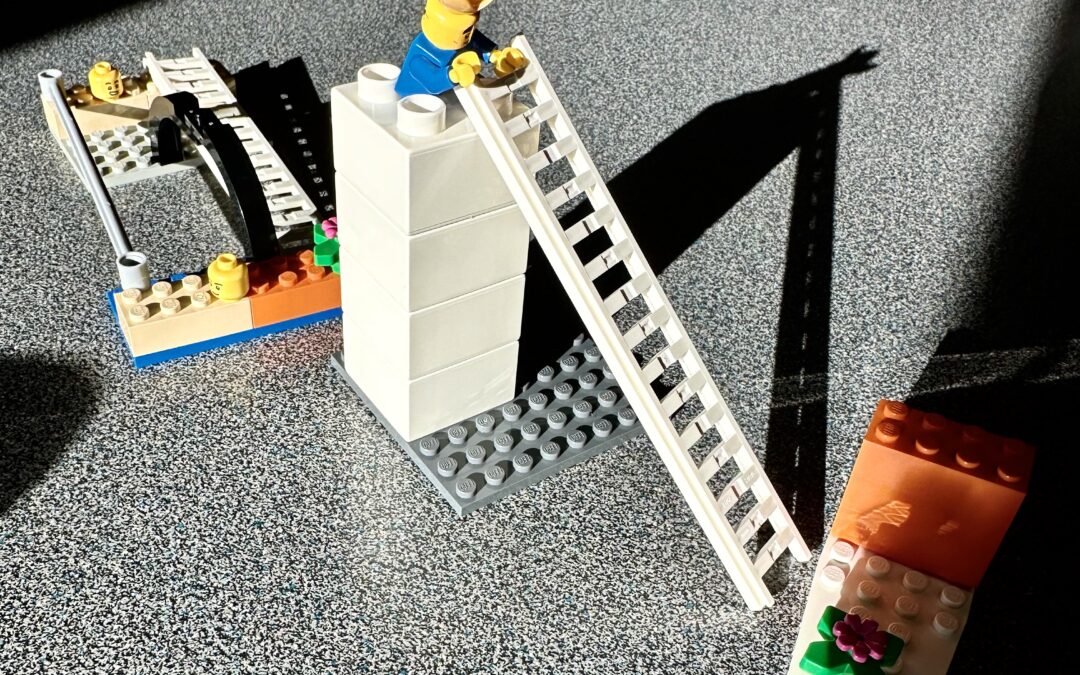
Photo by Jeff Smith, taken during a LEGO® SERIOUS PLAY® session.